
InterTone user guide
Every control, from the display down. InterTone holds a source to a target tone: you set the target once, and it keeps pulling the sound back to it.
The display
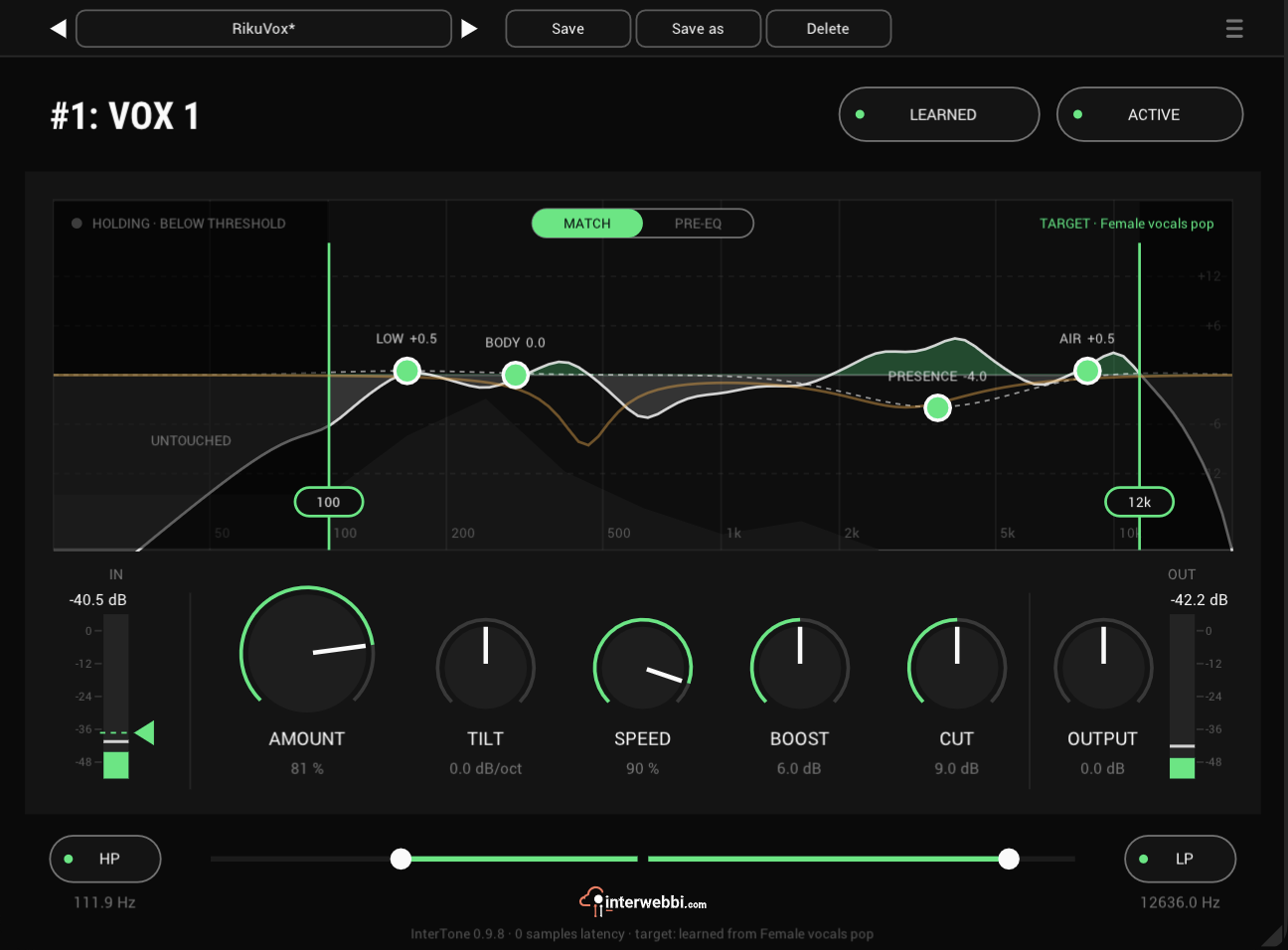
The dashed line is the target, with the region handles riding on it. Over it runs the correction InterTone is applying right now, and the display says whether it is adapting or holding, and what the target is: balanced, learned from the input, or a reference file's name.
Pre-EQ
Four nodes · ±18 dB, 20 Hz to 20 kHz, Q 0.3 to 10 · flat by default
MATCH / PRE-EQ at the top of the display chooses what you edit. In PRE-EQ the matching dims and four amber nodes appear; in MATCH the pre-EQ shows as a dim amber line.
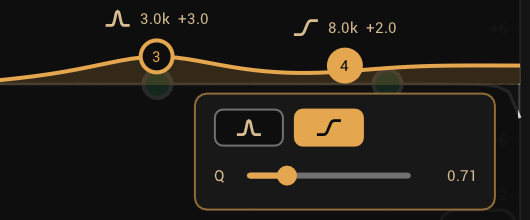
Drag a node for frequency and gain, and scroll on it for Q. Right-click it for Q and, on nodes 1 and 4, a choice of bell or shelf; nodes 2 and 3 are bells. Double-click puts a node back where it started, and shift-click switches it on or off.
The pre-EQ comes after HP and LP and before the matching. The matching hears it, leaves half of it alone and pulls the rest toward the target, so a pre-EQ move stays in part even at a high AMOUNT.
Tone regions
±18 dB each · LOW 60 to 300 Hz · BODY 150 to 800 Hz · PRESENCE 1 to 6 kHz · AIR 6 to 16 kHz
Each region raises or lowers the target in its own range and leaves the rest where it was. Drag a handle up or down for its level and sideways for its centre frequency. Double-click a handle to put it back at its default. Shift-click switches its region off, and InterTone then corrects nothing around it.
Processing range
20 Hz to 20 kHz, off at the ends
Drag the two tabs at the foot of the display inward to tell InterTone where to work. Outside the range the sound is untouched, and the correction fades out over a third of an octave past each edge. Double-click a tab to send that edge back to its end.
Learn target
Replaces the balanced target with one measured from the input, at soundcheck, or from a reference file (WAV, AIFF, MP3 or FLAC), or with one of six factory targets: female and male speech, pop vocals and rock vocals. Tilt and the regions then move it from there.
A click always opens a menu first, so one stray click during a show cannot overwrite the soundcheck. The same menu saves a learned target under a name, loads it on any other track and deletes it.
Amount and tilt
Amount 0 to 100%, default 50% · Tilt −6 to +6 dB per octave, default 0
AMOUNT sets how much of the correction is applied, the regions included: at 50% a region lands at half its value. TILT leans the whole target darker or brighter about 1 kHz.
Speed
0 to 100%: 5.6 s to 0.16 s
How quickly the correction follows the sound. Release is a tenth of it, at least 0.1 s, so a correction lets go quickly even at slow settings.
Boost, cut and output
Boost 0 to 12 dB, default 6 · Cut 0 to 18 dB, default 9 · Output ±24 dB
BOOST and CUT are the furthest the correction may go either way, and BOOST limits a region boost too: if one stops short, turn BOOST up. OUTPUT sets the level that leaves.
Threshold
The wedge on the input meter, default −40 dB
Below the wedge, InterTone stops adapting and holds the correction where it was, rather than chasing a quiet signal. LEARN counts only what is above it.
HP and LP
HP 20 Hz to 1 kHz · LP 1 to 20 kHz
A high-pass and a low-pass filter, each with its own on and off switch. They are part of the target, so the correction never boosts back what they cut.
Active, presets
ACTIVE bypasses the whole plug-in.
The preset bar across the top saves, loads, steps through and deletes presets. A preset holds everything, the learned target included, and its name gains a star when you change something.